Trolling Politically (Video Games in Populism) (Sort of)
While the most dedicated adherents to #Gamergate condemned the many acts of harassment which they attributed to third-party trolls, and which included doxing and death threats, the truth of the matter is that without such harassment, #Gamergate could not have existed. It was this very harassment of Quinn that led Sarkeesian to put forward her opinion on the scandal. It was the harassment of both Quinn and Sarkeesian that finally pushed the gaming press to publish their articles about ‘gamers’. The mass movement that followed, the cultural online populist movement, could never have risen to public consciousness without its most derisive elements. Actual gamers who were pulled into the mess may very well have wished that the whole thing never happened, that their cultural power as a group was never threatened. #Gamergate did not necessarily benefit them. Those who necessarily benefited, however, were the online-right who found in the movement a way to neutralize and attack their political and cultural enemies. These actors, such as Milo Yiannopoulos, saw the value in generating outsized reactions to fuel their political agenda. They saw the value in trolling. Indeed, Nagle writes that, “the troll-y version of the right that Milo represents is able to fight the new online identity politics in a way that actual conservatives are not able to. They understand the value of transgression, edginess and counterculture often better than their left-wing opponents” (60). This use of trolling for political gain is seen most clearly in the Trump presidency. In his use of such tactics, however, he has inadvertently introduced a new gamified type of politics. Indeed, one of the key aesthetics of video games, one that used to solely belong to video games and interactive fictions such as choose your own adventure books and tabletop roll playing games, has now hopped into political speech through the vehicle of trolling. This is the concept of forced-choice incompleteness.
Political Image as Interactive Fiction. It is common sense in 2020 that trolling is a tactic wherein the content of the troll-statement is irrelevant, so long as it ignites a reaction from its target. The statement can be true or not true, genuinely felt or lies, so long as its intention is to garner such a reaction. In a remarkably insightful video from MSNBC¸ host Ari Melber states, “Trolling works by tricking people and exploiting their overreaction. It works less when people properly identify the trolls in their midst” (MSNBC, 00:53-01:02). Online, this type of activity either provokes a one-off reaction, or is spotted and correctly identified as a troll and thereby nullified. In person, with a friend, or even a stranger, this type of behavior yields similar results: the friend will either react (but still know the troll’s genuine beliefs, due to the friendship) or call out the troll, and the stranger will likewise either react (after which the two interactants will go their separate ways) or ignore the attempt. Where things get interesting, however, is when trolling enters the public space, and contributes to one stable perceived image. It becomes even more interesting when used politically, wherein one cannot achieve power without at least sometimes being genuine. Of trolling politically, Melber states, “Political trolling is a little different, because it exploits political differences to present different messages to different ideological audiences through the same single act of trolling” (MSNBC, 02:43-02:53).
It is here, at Melber’s site of “different messages,” that it is worth turning to the aesthetics of video games. Looking again to the article, “Interactivity, Fictionality, and Incompleteness,” by Nathan Wildman and Richard Woodward, they describe a type of fictional incompleteness found only in video games and other media deemed interactive fictions. They describe this as “forced choice incompleteness” (Wildman and Woodward, 122). In defining a work or object that carries this forced choice incompleteness, they say:
A work is forced choice incomplete with respect to p just in case (a) there is no prescription to imagine p and no prescription to imagine not- p (i.e., p is neither fictionally true nor fictionally false) and (b) there is a prescription to either imagine p or imagine not- p. … Understanding the second clause is crucial here. To say that there is a prescription to either imagine p or imagine not- p is not to say that there is a prescription to imagine the disjunction, p or not- p . One does not comply with the prescription to either imagine p or imagine not- p by imagining a disjunction: one complies with it by imagining one of the disjuncts. And though there is no requirement to imagine one disjunct rather than the other, there is a requirement to either imagine one disjunct or to instead imagine the other. … The concept of forced choice incompleteness, we submit, allows for the demarcation of a kind of incompleteness that sheds new light on our understanding of interactive fictions. In particular, it allows us to address the puzzling question of how we can reconcile the idea that interactive fictions leave certain questions about the fictional goings-on open , whilst at the same time allowing that, in a given interaction, the fictional goings-on are settled by the choices made by the appreciator. (122)
Wildman and Woodward sketch out here the difference between standard fictions like novels and films, and interactive fictions like video games. A novel may leave certain things fictionally open to interpretation or decision, but one is not forced to choose how to remedy that incompleteness in order to continue the story. In video games, one is met with a series of choices that determine the fiction of the story. Players are forced to make the decision in order to “close” or “complete” the fiction. In this situation, the player is not forced to choose any one side of a decision, but they are forced to make the decision itself. An option must be chosen, or the fiction is incomplete.
Turning back to Trump, then, one can see this concept of forced choice incompleteness present itself in the political sphere. This is possible only through trolling. The example Melber uses in the MSNBC video will be the same example used here. To prove his point, Melber presents Trump’s infamous Cinco de Mayo tweet, wherein the president writes, “Happy #CincoDeMayo! The best taco bowls are made in Trump Tower Grill. I love Hispanics!” and in which there is a linked photograph of Trump smiling while eating a taco bowl (see fig. 1.).
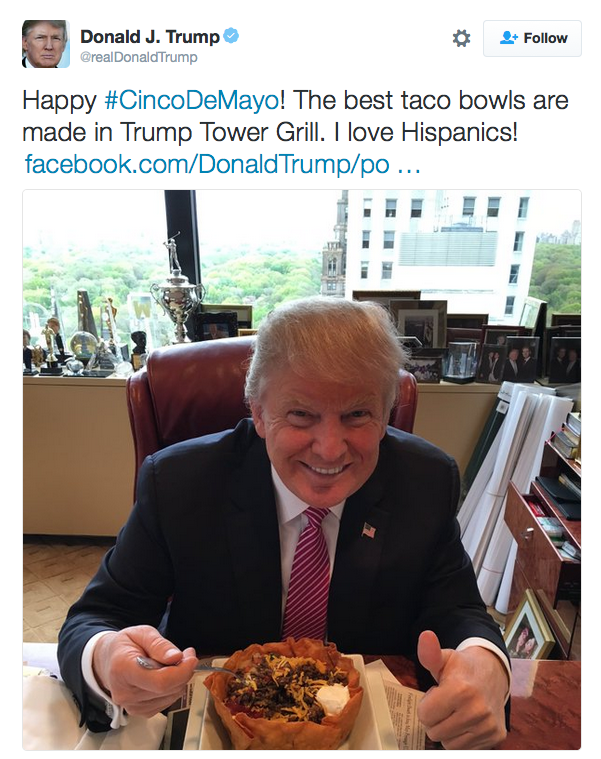
Of this tweet, Melber states, “you’re looking at classic trolling right there: the pic says one thing to Trump’s base who liked his message, and like even more how it will certainly make his critics’ heads explode. Earnest reactions to this kind of thing risk falling into the trolling trap” (MSNBC 03:00-03:13). When trolling is introduced as a standard mechanic within a leader’s political discourse, the leader’s political image then opens up to be determined by the listener, since one can never know, for certain, which statements are trolls and which are not. This is inherent in the design of trolling, which is meant to be taken as genuine by the targeted party. In this way, one must make a decision pertaining to each statement this leader makes. For the above Cinco de Mayo tweet, there are three choices one can make about Trump’s beliefs and intentions, and for each of these—depending on one’s political leanings—a negative or positive reaction. The choices and reactions will be laid out here with a corresponding potential statement or thought of those who make each choice, followed finally by who these people potentially are:
1. He is trolling and genuine (good reaction). ‘Trump really loves Hispanics, but knows his phrasing (politically incorrect but completely fine) will upset PC liberals.’ This will be his core base.
2. He is trolling and genuine (bad reaction). ‘He really believes this is a proper way to celebrate Hispanics (ignorant) and has no desire to learn the proper way. He just wants to make people upset with his ignorance by shoving it in our faces.’ This will be opponents inclined to favor an interpretation of trump that pins him as being more unintelligent.
3. He is trolling and not genuine (good reaction). ‘Whether he cares about Hispanics or not is irrelevant. Maybe food is all they’re good for anyway. But it’s great the way he angers the SJWs. Build the wall.’ This will be Trump’s segment of more ‘wink-wink’ racist supporters.
4. He is trolling and not genuine (bad reaction). ‘He doesn’t love Hispanics, and this proves it. This is only a way to make us angry and cater to his racist base, showing them exactly how he views immigrants: as the help. He really just wants to sow division.’ This will be Trump opponents who favor an interpretation of Trump as being more malicious.
5. He is only genuine (good reaction). ‘Why is everyone upset? Hispanic food culture is a precious gift to America and Trump supports that. He said he loves them. People will get upset over anything.’ This will be potential supporters, not fully aware of trolling as a political concept, who are tired of politically correct culture.
6. He is only genuine (bad reaction). ‘How is this man running for president? The ignorance is astounding, and hurtful for those he seems to want to respect. We cannot have a fool like this in the White House.’ This will be potential opponents, not fully aware of trolling as a political concept, who care about social justice.
The crucial point to consider when examining these disparate interpretations and choices is that the reader of the tweet must choose one in order to determine was is true about their conception of Trump’s political image. Each choice is valid and can be considered a credible interpretation, and yet many directly contradict each other. Even though the content of the tweet, or statement, remains the same, its meaning does not. Trolling becomes part of its content, whether one believes it to be a troll or not. In this way, without making the choice, the statement actually loses meaning; it becomes politically meaningless. And because this is not a one-off statement, and in fact belongs to a political figure whose very existence as a political figure relies on reactions to his speech over time, the tweet can be considered one of many instances of this forced choice, each contributing to the now interactive fiction of Donald Trump. One can begin to see, through this lens, why certain reactions to Trump, and reactions to those reactions, continue to polarize the nation over which he is presiding. Indeed, the relationship between this gamified rhetoric and polarization can be examined much further, but it is beyond the scope of this particular investigation, which has only aimed to reveal a hidden and striking similarity between Trump’s populism and the aesthetics of video games.
This new political rhetoric, as championed by Donald Trump, turns its speaker’s political image into an interactive fiction, one which can be defined by those listening. And although #Gamergate is not fully responsible for trolling, just as the aesthetics of video games are not responsible for #Gamergate, it is nonetheless interesting to consider that the event many believe to be the beginning of a new era of online political discourse was one centered on video games, and that the end result was a gamified version of political speech itself.
Works Cited
Aarseth, Espen. “Doors and Perception: Fiction vs. Simulation in Games.” Jouer Intermédialités, no. 9, Oct. 2011, pp. 35–44.
Alexander, Leigh. “’Gamers’ Don’t Have to Be Your Audience. ‘Gamers’ Are over.” Gamasutra, gamasutra.com/view/news/224400/Gamers_dont_have_to_be_your_audience_Gamers_are_over.php.
Bartel, Christopher. “Ontology and Transmedial Games.” The Aesthetics of Videogames, Routledge, 2018, pp. 9–23.
Bauwel, Sofie. “Women Gamers.” The International Encyclopedia of Gender, Media, and Communication, Mar. 2020, pp. 1–4., doi:10.1002/9781119429128.iegmc046.
Comedy Central. “The Colbert Report – Gamergate – Anita Sarkeesian.” YouTube, 30 Oct. 2014, https://www.youtube.com/watch?v=9L_Wmeg7OTU
Etchells, Pete. “Five Damaging Myths about Video Games – Let’s Shoot ‘Em Up.” The Guardian, Guardian News and Media, 6 Apr. 2019, http://www.theguardian.com/games/2019/apr/06/five-damaging-myths-about-video-games-lets-shoot-em-up.
Fukuyama, Francis. Identity: Contemporary Identity Politics and the Struggle for Recognition. Profile Books, 2019.
Golding, Dan. “The End of Gamers.” Dan Golding, 28 Aug. 2014, dangolding.tumblr.com/post/95985875943/the-end-of-gamers.
Juul, Jesper. Half-Real: Video Games between Real Rules and Fictional Worlds. MIT Press, 2011.
Kazin, Michael. The Populist Persuasion: an American History. Cornell University Press, 2017.
Klein, Ezra. “Gamergate and the Politicization of Absolutely Everything.” Vox, Vox, 1 Nov. 2014, http://www.vox.com/2014/11/1/7136343/gamergate-and-the-politicization-of-absolutely-everything.
Lavandier, Anna-Michelle. “Debunked: The ‘Gamer’ Stereotype.” Medium, The Nerd Castle, 7 Oct. 2016, medium.com/the-nerd-castle/debunked-the-gamer-stereotype-69be0e4ee0d7.
MSNBC. “How President Donald Trump Uses Trolling As Political Warfare | The Beat With Ari Melber | MSNBC.” YouTube, 30 May 2018, https://www.youtube.com/watch?v=yZGPf0D-T6w
Nagle, Angela. Kill All Normies Online Culture Wars from Tumblr and 4chan to the Alt-Right and Trump. Zero Books, 2017.
Paaßen, Benjamin, et al. “What Is a True Gamer? The Male Gamer Stereotype and the Marginalization of Women in Video Game Culture.” Sex Roles, vol. 76, no. 7-8, Oct. 2016, pp. 421–435.
Plante, Chris. “An Awful Week to Care about Video Games.” Polygon, Polygon, 28 Aug. 2014, http://www.polygon.com/2014/8/28/6078391/video-games-awful-week.
Plunkett, Luke. “We Might Be Witnessing The ‘Death of An Identity’.” Kotaku, Kotaku, 28 Aug. 2014, kotaku.com/we-might-be-witnessing-the-death-of-an-identity-1628203079?utm_campaign=Socialflow_Kotaku_Facebook&utm_source=Kotaku_Facebook&utm_medium=Socialflow.
Sargon of Akkad. “Angry Joe, TotalBiscuit and #GamerGate.” YouTube, 9 Feb. 2015, https://www.youtube.com/watch?v=4Uf9kS7Rp3Y
Shaw, Adrienne. “What Is Video Game Culture? Cultural Studies and Game Studies.” Games and Culture, vol. 5, no. 4, 2010, pp. 403–424.
Shaw, Adrienne. “Do You Identify as a Gamer? Gender, Race, Sexuality, and Gamer Identity.” New Media & Society, vol. 14, no. 1, 2011, pp. 28–44.
Smuts, Aaron. “What Is Interactivity?” The Journal of Aesthetic Education, vol. 43, no. 4, 2009, pp. 53–73.
Tavinor, Grant. “Bioshock and the Art of Rapture.” Philosophy and Literature, vol. 33, no. 1, 2009, pp. 91–106.
The Rubin Report. “Milo Exposes Gamergate (Pt. 2) | Milo Yiannopoulos | POLITICS | Rubin Report.” YouTube, 7 Oct. 2015, https://www.youtube.com/watch?v=r3r0atokQvc
“The Video Game Revolution: ‘Eight Myths About Video Games Debunked’ by Henry Jenkins.” PBS, Public Broadcasting Service, http://www.pbs.org/kcts/videogamerevolution/impact/myths.html.
Voelz, Johannes. “Toward an Aesthetics of Populism, Part I: The Populist Space of Appearance.” Yearbook of Research in English and American Literature, no. 34, Dec. 2018, pp. 203–228.
Voelz, Johannes, and Tom Freischläger. “Toward an Aesthetics of Populism, Part II: The Aesthetics of Polarization.” Yearbook of Research in English and American Literature, no. 35, Dec. 2019, pp. 261–286.
Waugh, Rob. “GamerGate – What Is It, and Why Are Gamers so Angry?” Metro, Metro.co.uk, 10 Dec. 2019, metro.co.uk/2014/10/15/gamergate-what-is-it-and-why-are-gamers-so-angry-4907102/.
Wildman, Nathan, and Richard Woodward. “Interactivity, Fictionality, and Incompleteness.” The Aesthetics of Videogames, Routledge, 2018, pp. 112–127. Young, Cathy. “(Almost) Everything You Know About GamerGate Is Wrong.” Medium, Arc Digital, 1 Jan. 2020, arcdigital.media/almost-everything-you-know-about-gamergate-is-wrong-c4a50a3515fb.

 NickDeNardi.com
Leave a comment