Setting the Scene
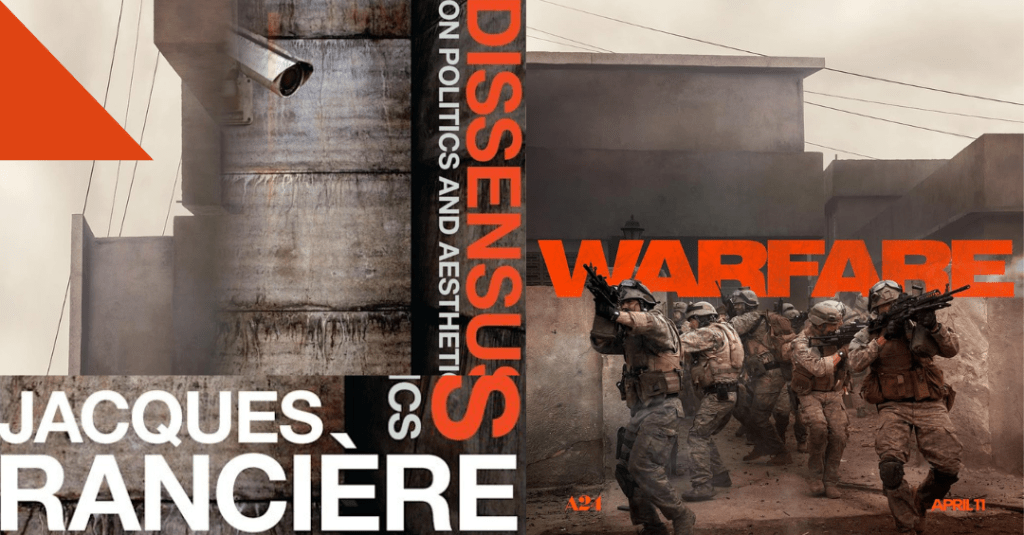
The reviews of Alex Garland’s Warfare are essentially unanimous: it is a good film. The arguments that ensued upon its release were not about its cinematography, sound design, tension, atmosphere, performances, or any of the things that make for an impactful aesthetic experience. No, the arguments boiled down to a rather simple question about the film’s purpose: “is this propaganda?” The film notoriously excludes any and all socio-political context to the conflict it so brutally relays on screen, and yet it is precisely this absence of political context that convinced many viewers of its political motives. By sealing its central conflict in a vacuum and refusing to editorialize about the political mechanisms behind the Iraq war in which it is set, the film becomes vulnerable to political commentary on all sides. It is praised and scorned alike for being pro- and anti-America, pro- and anti-war, and, most universally, it is criticized for having no point at all.
For me, this confusion points to a deficiency in the current cultural moment about what we want from our art. From our entertainment. I am generalizing, obviously, but it still feels true that we either want our movies to be non-political, or completely political. But don’t misunderstand me, either. I am not saying audiences want to be hammered with political messaging when they see a political movie. Clearly this is not the case: just look at reviews for 2021’s Don’t Look Up, which are mixed at best (and general audiences liked it even less). No, what I am pointing out here is that if a movie is going to be political, we expect it to be nuanced, complicated, and to show all sides of whatever quagmire it is presenting. But that doesn’t sound so bad, does it?
Look at the big three political films of 2025, all of which released mere months after Warfare and within months of each other as well: One Battle After Another, Bugonia, and Eddington. There are different emphases on different kinds of political impact, and different focuses on character and society (and different uses of Emma Stone), but by and large these films are praised for capturing a political moment. They succeed, in our eyes, where a film like Warfare fails. They present all sides, while Alex Garland’s Warfare presents no sides (or in the opinion of incorrect critics and defenders alike, just one side). But this binary is the deficiency I am talking about. Having a distaste for Warfare because it does not contextualize itself shows that we care more about our art accurately representing a political state of affairs than we care about it actually having an impact on one, as a work of art. It shows that if a movie traffics in politically-adjacent situations, we want it to (re)present the truth of a zeitgeist that we recognize, not illuminate the truth of a single interaction that could rupture how we think about that zeitgeist.
This where French theorist Jacques Rancière would sit next to Alex Garland at the bar, pat him on the shoulder, and reassure him that his politic-less aesthetics is closer to an aesthetic form of politics than any of the other films mentioned here. That by being closer to pure aesthetic, Garland’s works actually have more political weight, not less.
Rancière for the Masses
The lay-philosopher with interest pointed toward the “continental” side of things will more likely know Žižek or Habermas before they take up French theorist Jacques Rancière. But I believe a corrective is in the air. Over the last 15 years, since the publication of his collected works on politics and aesthetics in 2010 called Dissensus, Rancière’s ideas have only grown more potent. The neo-Frankfurt School is currently building upon Rancière’s foundations to construct a new “aesthetics of democracy,” and in popular culture, filmmakers like Alex Garland are interrogating a Rancièrian political reality within and without aesthetic objects.
But what exactly does that mean? The first thing to know about Rancière is that he positions both politics and aesthetics as domains whose central operation is their own reconfiguration. Take politics. For Rancière, politics is the activity of the entire domain of the political to impose new political subjects. He loves using the ancient peasant as an example here, because the peasant was once outside of politics; he did not count. As Rancière says: “The human beings who were destined to think and rule did not have the same humanity as those who were destined to work, earn a living and reproduce” (The Emancipated Spectator, 70). But as the domain of the political reconfigured itself, the peasant came to exist inside politics, to have a say in the political. The same happened with women and, in America, African Americans.
The way this happens is through Rancière’s famous concept, “dissensus,” wherein previously unknown subjects (from the POV of the domain of politics) rupture the status quo to make themselves seen. The peasant, as “the part with no part,” revolts against and into the system until their part is named and accounted for. This is the entirety of politics for Rancière; policies and ways of governing are mere administration. Under these terms, then, politics is always disruption.
Similarly, aesthetics is also a domain whose function is to reconfigure itself, this time through art. We, as subjects, navigate through what we think is the world. But as art both captures the world and intimates an unseen world, it redistributes what can be seen, heard, and interacted with. Similar to the emergence of political subjects, art, through dissensus, can make seen what was previously unseen. But even that is not a powerful enough description; it is not that art shows us hidden objects or experiences we simply haven’t interfaced with yet. More than this, art can reconfigure what is even sayable, seeable, or thinkable, not by its messaging or content, but through its aesthetic experience (which includes that content).
And this is why “critical art,” or art that attempts to make us more aware of a political situation (and therefore more able to change that situation), is doomed to fail. This is where films like Warfare and its predecessor, Civil War, carry more potential for political impact, precisely due to their apolitical (read: purely aesthetic) rendering of politics.
Rancière writes in The Emancipated Spectator, “critical art [posits] a straightforward relationship between political aims and artistic means: the aim is to create an awareness of political situations leading to political mobilization. The means consist in producing a sensory form of strangeness, a clash of heterogeneous elements provoking a rupture in ways of seeing and, therewith, an examination of the causes of that oddity” (74, emphasis mine). Here he is laying out the typical formula used by films like One Battle After Another, Eddington, and Bugonia. In each of these, the contemporary political situation is used as a launching pad for more absurd characters and situations which, if conveyed properly by the respective artist (Paul Thomas Anderson, Ari Aster, Yorgos Lanthimos) will then boomerang back around to highlight the inherent absurdity of the political situation itself. Satire is the most obvious reference point here, but these films would be done a disservice to be categorized as such. They earnestly seek to capture the political moment and to provoke thoughts, conversations, and perhaps even actions through that capture.
But if we remember the two domains Rancière sets out for us, that the political can only reconfigure itself just as the aesthetic can only reconfigure itself, we can anticipate his issue with the kind of political films we are talking about. It is simply that “the aesthetic break [is] absorbed into representational continuity” (The Emancipated Spectator, 75). In other words, films that overtly incorporate their political backdrop into their narrative content are, in reverse proportion, numbing the aesthetic effect of that content. What should be a redistribution of senses, of how we sense, becomes instead a mere replay of the sensible world we already know (our “representational continuity”). And this occurs both in the dilution of the aesthetic experience itself as well as in its prescription to act. By framing itself within political reality to enable us to act upon political reality, it signals that the aesthetic experience is secondary to political reality. Its form and content are both compromised.
This is a problem if the artists simply want to create art, as I believe the three directors of the aforementioned films ultimately wanted to do. They, like Alex Garland, did not create propaganda. But by using our political moment as both the contextual backdrop and punchline of their work, the films imply a certain belief in the power of doing so. They insist upon their own political weight. For Rancière, this counterintuitively diminishes their aesthetic power.
Furthermore, even if their goal is to overtly provoke political action, Rancière shows that their methods have the opposite effect! Diminished aesthetic power means diminished impact upon the senses, which means less chance for a significant rupture in how one thinks, how one maps the experience of their thinking. This, ultimately, reduces the odds of future political rupture (which, again, is the entirety of politics for Rancière). For a work to have what he calls “aesthetic efficacy” upon our shared lifeworld, it must paradoxically “rupture any determinate link between cause and effect” from itself to that world (The Emancipated Spectator, 63). The most impactful or “critical” art, writes, is “not so much a type of art that reveals the forms and contradictions of domination as it is an art that questions its own limits and powers, that refuses to anticipate its own effects” (Dissensus, 149).
Alex Garland: The Rancièrian Candidate
None of this is to say that the content or topic of a work of art means nothing in relation to its potential impact. Aesthetic experience is an interplay between world and non-world, between sense, thought, and emotion. While it is possible that a Jackson Pollock painting could result in one having a different experience of their thoughts about immigration, it would be unlikely. But again, art that implies its own political power also has no direct ability to remap one’s experience of the world, since it is only replaying that world. The paradoxical conclusion for Rancière, then, is for art to maintain a bundle of sensory experiences related to a topic, but in a way that completely and utterly accepts its own political impotence. To turn the political into art by removing its politics. He writes, “ one of the most interesting contributions to the framing of a new landscape of the sensible has been made by forms of art that accept their insufficiency […]” (Dissensus, 149).
In short, the best way for aesthetics to be political is to treat politics as aesthetically as possible. Usually, this is the part where you and I ask, “well, what does that even look like?” and usually, the response is some lackluster list of experimental short films or exhibit art pieces. But in the last couple years, one madman mainstream director has actually taken up Rancière’s challenge, and his name is Alex Garland. His last two films, Warfare (2025) and Civil War (2024), feel as if they are direct attempts to capture and transform the political into the aesthetic, with no politics left over. Whereas the previous three films attempt to couch a story within politics, Garland seeks to convert politics into story.
Take Civil War. When seen through the Rancièrian lens, it is almost comical how every aspect of the film is political, yet has absolutely no politics to speak of:
- There is a third-term president; we do not know his politics or how he came to be in this situation.
- There is a civil war; the secessionists are the combined forces of Texas and California — we do not know their politics or how they came to be in this situation.
- The protagonists are journalists who want to interview the president before he is killed; they are willing to embed themselves into the secessionist forces, but as their profession implies, they do not care what happens as long as they are there to capture it, and that it is a good story. We do not know their politics or how they came to be in this situation.
The context surrounding the eponymous civil war is unknown, and uninterrogated. In a kind of meta-narrative, the story is rather about how to capture itself; it is a road trip through political intensities sans the founding narratives of a contemporary political moment. The photojournalists, as presented in this fiction, become stand-ins for the political function of fiction more broadly, to navigate the political with as little politics as possible.
In perhaps its most notorious scene, Garland (who is also the writer of the film) anticipates the reaction of “politically” minded viewers to seek more narrative grounding. The photojournalists find themselves thrown into the middle of a sniper fight across an abandoned Christmas fair (do with that what you will). They seek cover next to soldiers with unknown affiliation as they exchange fire with the “enemy” in a faraway structure. While one journalist takes photos of the soldiers lining up their shot, another asks them, absurdly, “hey, what’s going on?”
One soldier replies: “there’s someone in that house. They’re stuck. We’re stuck.”
Journalist: “Who do you think they are?”
Soldier: “No idea.”
Journalist: “Hey. We’re press.”
Soldier: “Cool.”
Journalist: “Are you WF? Who’s giving you orders?”
Soldier: “No one’s giving us orders, man. Someone is trying to kill us. We are trying to kill them.”
Journalist: “You don’t know what side they’re fighting for?”
Soldier: “Oh, I get it. You’re retarded. You don’t understand a word I say.”
Finally the other soldier with the rifle chimes in, “guys, shut the fuck up,” and summarily headshots the enemy from across the abandoned fair. One journalist looks at the blooming flowers.
Rancière himself could not have dreamed up a better example of the nature of art and its relation to a political situation. This scene asks us a crucial question and answers with the gravitas true to aesthetic experience. The question is: what is the function of a situation? The answer, in no uncertain terms, is not to explain itself, but to resolve itself. “Understanding” the politics a fiction brings into a situation does nothing to help its function. The photojournalist, in going from journeyman to captive of a situation, mirrors the crossing between fiction and spectator. And for Garland, he is quite tired of entitled spectators. He prefers emancipated ones. His fiction, being grounded in- and untethered from reality, deserves to take its shot.


 NickDeNardi.com
Leave a comment