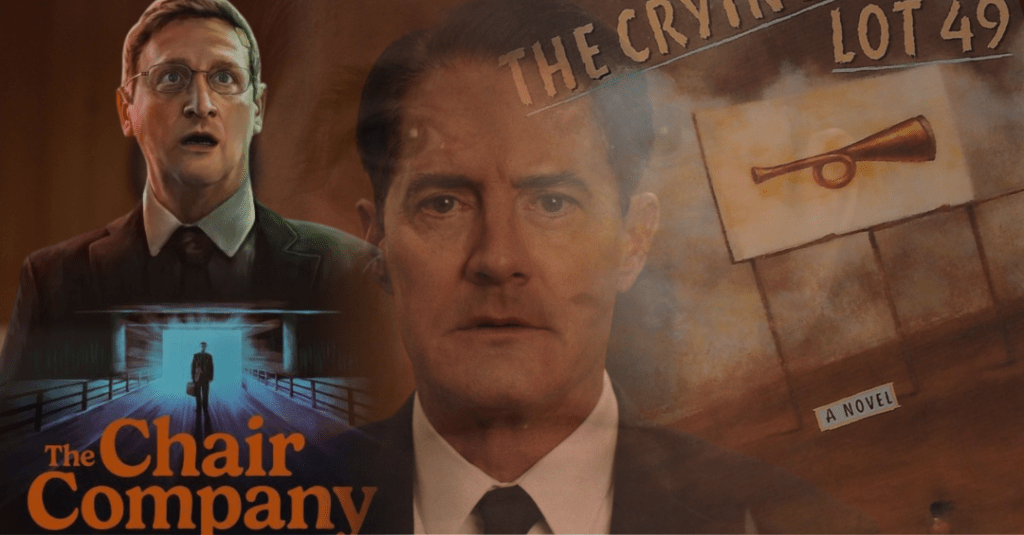
There is a certain focal point that separates what I would call auteur post-structuralists (like Lynch, Pynchon, and (absurdly) Robinson) from run of the mill postmodernists. And that focal point is alienation. For the post-structuralists, alienation is a way of life. Or rather, it is the way of life (of the human subject). Pesky orders like late-stage capitalism and hyperreal online networks and algorithms may exacerbate that fact, but they do not define it as they do for critical theorists. Put simply: for the post-structuralists, we are born alienated. It is, as defined by theorist Rahel Jaeggi, “a deficiency in one’s relations,” and therefore a deficiency in oneself. Something is missing and we are, quite literally, born to figure it out what it is. Not to solve the problem, mind you, but to always be in the act of solving it.
This kernel of post-structuralist thinking is nothing new (and is in fact something of a nonstarter, praxis-speaking) in theory and philosophy. But on the heels of postmodernism, works that have attempted to aestheticize (i.e. to capture the experience of) this ontological reality of alienation have often been confused with the former. The Crying of Lot 49 by Thomas Pynchon, for example, is to this day still referred to as a seminal work in postmodernism. But this deserves further investigation. At its core, The Crying of Lot 49 is a detective story in its purest form. By which I mean, as opposed to murder-mystery or thriller novels, Pynchon is focused here on detecting in and of itself. The novel’s protagonist, Oedipa Maas, is trying to uncover something without knowing what the thing uncovered could even be. She sees clues everywhere, and the potential meaning of the mystery is always right around the corner.
So if we take postmodernism’s founding principle — the rejection of grand narratives and inherent meaning — something doesn’t quite add up. A story of someone seeing and seeking meaning everywhere, and it actually being there (although out of reach) should not count, should it? If postmodernism’s message is the negation of meaning, Lot 49 negates even that message. The perpetual chase of meaning (facilitated by actual clues) within the novel implies and perhaps even necessitates its existence, even if it is always just out of reach. This is why Pynchon, Lynch and Robinson (as we will see) forego any “grand” symbolic messaging in their work, even if that message could be “there is no message.” The goal is not to smugly shrug and say “nothing matters,” but rather to conjure experiences of everything being connected. To make-aesthetic the human state of being that is never complete in itself. Robinson, Lynch, and Pynchon show there is a difference between the meaningless world of postmodernism, and a meaningful world that does not (yet) make sense.
And it is this “yet” that is the defining characteristic of ontological alienation. The feeling that something is forever lacking, but in that lacking, implies the existence of that which would resolve it. To be less than, in other words, is to always be less than something. And this “yet” is exactly where Pynchon ends Oedipa Maas’s investigation into the secret society Trystero in The Crying of Lot 49. The novel builds to a narrative climax that will finally solve her mystery, yet concludes as she is about to get her answer. The crying of lot 49 at the auction is the sound of Oedipa’s (and our) impending meaning.
Watchers of David Lynch’s Twin Peaks: The Return will recognize this aesthetic move. Only, Lynch takes it one step further and actually provides quote-unquote “closure” in Part 17 of the 18-part series. Where Pynchon teases narrative conclusion, Lynch negates it by continuing past it. This is intimated by the names of the respective episodes themselves. Part 17 is titled “The Past Dictates the Future,” a strong affirmation of narrative-based conclusion. Part 18, conversely, is titled “What is Your Name?” — the beginning of an entirely new conversation. Part 17 ends the central conflict, and Part 18 reveals the conflict that was always behind the conflict, raising fundamental questions about the nature of the world Special Agent Dale Cooper has been navigating from the start.
And for Lynch, what is fundamental to this world-reset is that it is only a “reset” for the subject who experiences it. Remember, the deficiency in one’s relations is a deficiency in oneself. The alienation is inside us. If we discovered the gravity particle tomorrow and our entire view of the universe changed, causing us to ask even more terrifying questions and to reevaluate old answers that no longer make sense, we obviously would not say the universe itself has changed. It was always like this, and the signs were always there. This is how Lynch treats his film worlds. There is always an immanent subject, connected to and part of a world they participate in narratively unraveling. And there is nothing Lynch loves more than finding an answer that presupposes new questions and recontextualizes all the old answers you thought were safe.
And this brings us, astonishingly, to Tim Robinson. He and other post-reality comedians (see: Nathan Fielder, Conner O’Malley) have jimmied their way into specific veins of the American zeitgeist. But in his new(ish) HBO show, The Chair Company, Robinson positions himself alongside the likes of Lynch and Pynchon in the very specific way addressed here. Indeed, I am not making the blanket statement that Robinson’s show is “Lynchian” in a visual or surrealist sense. Benny Safdie and Nathan Fielder’s The Curse fits that bill more strongly. No, the affinity The Chair Company has with Twin Peaks: The Return and The Crying of Lot 49 is again in how it deals with alienation. And here it is also significant to mention: all three of these works are funny. In a sense, Robinson merely picks up where the others leave off and makes the entire enterprise of chasing meaning the joke.
But be careful. Because again, it would be unwise to walk away with the message that there is no meaning at all, or that it is pointless to chase it. Again, the The Chair Company captures the opposite: there is an excess in meaning and it is the point to chase it. But it’s funny that it has to be like that. The punchline is not us, the viewer, for ever having hoped for meaning. The punchline is the world, who always rips another gut punch and says “fuck you, here’s some more” before you kindly ask for another. And Robinson makes this clear in exactly the same way Lynch does. In the penultimate episode of the series, there is again that ominous quote-unquote “closure.” Only this time we are meant to laugh at how cleanly it all wraps up. The protagonist and central “detective,” Ron, smile-cries into a mirror over his wife’s shoulder for way too long, self-satisfied, happy, complete. And that is the central joke to the entire show. Not that meaning doesn’t exist, but that there is always more. And even when we think we are done searching, we are foolishly lying to ourselves. Why else was Ron staring into his own crying eyes in the mirror? He was convincing himself it was over, but the reflection was lies. Thus, another episode follows, and the nature of the mystery reveals itself to be even more insane than Ron could have ever imagined. The world is excess, and the subject is lack.
For Pynchon, the experience is confusing and paranoid. For Lynch, it is beautiful. For Robinson, it is downright hilarious.


 NickDeNardi.com
Leave a comment