[Spoiler-free section]
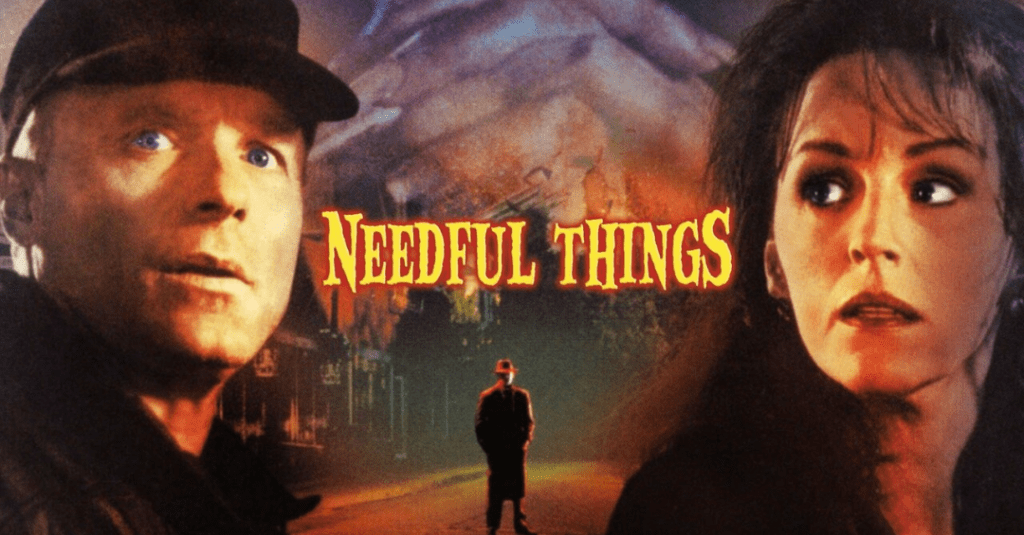
As a Constant Reader, my journey through Stephen King’s bibliography has been as meandering as anyone else’s. Early stuff to late stuff, coke stuff to sober stuff, the beautiful and the rotten. But in my reading of Needful Things, I realized about halfway through that I had never gotten around to his cynical stuff. A major thesis throughout his work (as I have gleaned so far) is that although we are easily corruptible, and although evil exists through man, we are at the same time worth saving, that it is possible to be saved. And this is why it took me 400 pages to understand where I was, while reading Needful Things. In the last Castle Rock story, King argues the opposite: we may survive, but anything that happens to us in the meantime is much-deserved. There is no saving, we will not learn our lesson, our pain is someone else’s joke, and perhaps that is the most horrible (but just) thing in the universe.
[Spoilers for Needful Things by Stephen King ahead.]
The book opens with the ominous decree: “YOU’VE BEEN HERE BEFORE.” And you know what, I’ll admit it: I thought I had King beat here. I never read any of the main Castle Rock stories before. This was in fact my first tour of the town. But of course, the joke was in fact on me, because King was not referring to Castle Rock. He was referring to the American way of life, which, in prophetic fashion, the book goes on to dismantle and destroy while laughing all the way. And after we bear witness to the decimation of this town, we are brought to another one, some unknown place called Junction City over in Iowa. And there, we are greeted the same way: “YOU’VE BEEN HERE BEFORE.” Only this time, it reads more like a goodbye-warning. Escape once, escape twice, you can’t outrun human nature. But you can laugh at it.
There are a couple characters treated with sympathy in Needful Things, but otherwise you can almost hear the book laughing at our easy capability for violence. People are hacked apart, blown up, shot, stink-bombed, crushed, vaporized and otherwise dismembered, all in the name of fine china, bedsheets, fishing poles, and the way of life that is not made possible by free-trade, but identical with it. Why shouldn’t the war be at home? Why not just kill each other rather than spread our stink and glut across the globe and force our precious way of life on all creation? Except it’s even more cynical than that. When you watch 11-year-old Brian Rusk of Castle Rock bring the barrel of the shotgun to his mouth and pull the trigger with his big toe while his seven-year-old brother watches, you get the feeling this could only happen if the empire of free trade had nowhere else to go.
I know, the “end of history” neoliberal There-Is-No-Alternative critique of capitalism as that which subsumes and then sells its own critique, is old hat. But the book was published in ’91, and if you ask me, it shows that King had his finger on the cultural fears of that time just as expertly as any other. The notorious “End of History” was published by Fukuyama just a year later, and the internet was well on its way even as some business were still phasing out their typewriters. The world was moving, but it was more like a whirlpool draining down (and still is). Every town becoming every other town, every desire a need, because desire is all we have left.
I won’t say Needful Things is a particularly powerful critique of capitalism or America or the death of small-towns or even the pitfalls of fetishized consumption (although the wordplay with that one is rather nice). It is about normal people being goaded into obliterating each other in often hilarious ways. Hilarious because the level of violence compared to the offenses that provoke it is absurd. But that feeling underneath the hilarity, that disturbances in our ways of consuming (which is our way of life) can so easily provoke scenes of chaos and gore, makes the novel equally disturbing. If we are always that close to snapping, always on the verge of violence against even our own neighbor, maybe we should just let it ride. Why pretend we’re any better than we are? We have made the world as we want it: full of wonderful things. To hell with the people. Let them all burn.


 NickDeNardi.com
Leave a comment